
Technology
A small, honest snapshot of what the VPS actually runs on.
Virtualization
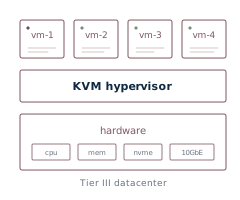
VPS instances are KVM virtual machines managed by an enterprise-grade hypervisor. Each VPS has dedicated allocations of vCPU cores, RAM, and SSD storage — no oversubscription on the disk side, light oversubscription on CPU within reasonable limits.
Hardware
Dual-socket Xeon servers with ECC memory and enterprise NVMe SSDs in ZFS pools. LZ4 compression is enabled across the board, which typically gives around 1.3× effective capacity on typical server workloads (more on text-heavy datasets, less on already-compressed media).
Hardware is refreshed on a multi-year cycle, not on every release. A modern Linux workload doesn't benefit much from a top-tier CPU; we prefer a generation-or-two-older platform with more memory and faster storage.
Network
Per-VPS NIC rate cap is 1 Gbps with no monthly transfer cap. The host uplink is shared; we don't meter outbound and use a fair-use policy instead — if a single VPS sustains line rate for days at a time, we'll reach out before throttling.
IPv4 and IPv6 both available. One IPv6 address per VPS, allocated from the host's /64.
Datacenter
Single facility in Northern Virginia, USA. The site itself is one of the established enterprise-grade East Coast facilities — Tier III equivalent power and cooling architecture, N+1 redundancy on power feeds and UPS, dedicated cooling with hot/cold aisle separation, 24/7 on-site security, biometric access controls, and continuous environmental monitoring.
Network presence at the facility is multi-100 Gbps with blended transit from multiple Tier 1 carriers and direct peering with major content networks. Latency to most US East Coast endpoints is in the single-digit milliseconds; to West Coast endpoints, low-double-digit. The site has formal SOC 2 and ISO 27001 attestation — which doesn't certify our service specifically, but does mean the building and its operations are audited.
We don't claim multi-region or multi-datacenter — single facility, single deployment. If Virginia is bad for your workload (compliance, latency to your users), this isn't the right host.
Backup architecture
Two independent layers. On-demand snapshots live on the same storage pool as the VPS — fast, ideal for "revert this bad change," but not disaster recovery: if that pool is lost, the snapshots go with it. Separately, we take off-site backups of every VPS to encrypted, geographically-separate storage, so your whole server can be recovered even if a host is lost entirely. You're still welcome to run your own in-guest backups on top (Restic, Borg, rsnapshot) if you want a copy under your sole control.
What we don't have
Setting expectations up front:
- No multi-region or multi-AZ failover.
- No managed load-balancer, CDN, or DNS hosting service.
- No auto-scaling or spot instances.
- No GPU-equipped hosts.
If your workload needs any of those, a hyperscaler will fit better. If it doesn't, this is a calmer, cheaper place to run it.